- Defining the Vision: What is Pleistocene Rewilding and Why Does It Matter?
- The Optimistic Agenda: Shifting from Preservation to Restoration
- The Great Debate: Analyzing Pleistocene Rewilding Pros and Cons
- Ecological Risks vs. Evolutionary Benefits
- A Global Map of Ambition: Regional Rewilding Projects
- North America: From Cheetah Proxies to Elephant Corridors
- The Arctic Experiment: Pleistocene Park and Permafrost
- Australia and South America: Managing Accidental Rewilding
- The Frontier of Science: Genetic Rewilding and the Ethics of Cloning
- De-Extinction: Can We (and Should We) Clone a Mammoth?
- Rewilding the Anthropocene: Anthropological and Social Perspectives
- Coexisting with Giants: The Human Element
- Actionable Steps for Modern Conservation Policy
- Building a Framework for Responsible Megafauna Restoration
- Expert Perspective: Functional Ecology
- Frequently Asked Questions
Defining the Vision: What is Pleistocene Rewilding and Why Does It Matter?
Pleistocene rewilding is not a mere nostalgic look at the past, but a forward-thinking strategy designed to repair the functional gaps in our current ecosystems. By reintroducing large mammals that are either direct descendants or functional proxies of extinct megafauna, scientists aim to restart ecological processes that have been dormant for over ten millennia.
Traditional conservation often focuses on preserving what remains, but this approach argues that what remains is already fundamentally broken. We are living in a “shorn” world, where the absence of massive herbivores and apex predators has led to a slow-motion collapse of biodiversity and habitat complexity.
The Optimistic Agenda: Shifting from Preservation to Restoration
The core of this movement is often called the pleistocene rewilding an optimistic agenda because it moves away from the “doom and gloom” of extinction statistics. Instead of just documenting the loss of species, this framework seeks to actively restore ecological functional roles that have been missing since the end of the Pleistocene epoch.
The 13,000-year benchmark is critical because it represents the time just before the massive pulse of extinctions that wiped out mammoths, mastodons, and giant ground sloths in North America. To restore true ecological health, we must look beyond the pre-industrial era and target the restoration of megafauna-driven processes that shaped the planet for millions of years. This shift requires us to accept that “wildness” is a dynamic state of being rather than a static point on a map.
The Great Debate: Analyzing Pleistocene Rewilding Pros and Cons
The transition from theory to practice involves navigating a complex web of scientific uncertainty and ethical friction. While the potential for ecological revival is immense, the introduction of large-bodied animals into a human-dominated world presents significant logistical and biological hurdles.
| Potential Benefits | Anticipated Risks and Challenges |
|---|---|
| Enhanced Carbon Sequestration: Large herbivores can transform shrublands into grasslands, which are more effective at sequestering carbon in the soil and reflecting solar radiation. | Invasive Behavior: Introduced proxies may not behave exactly like their extinct counterparts, potentially leading to the destruction of existing endangered flora. |
| Increased Biodiversity: Through “ecosystem engineering,” megafauna create diverse micro-habitats that support thousands of smaller species. | Pathogen Transmission: Moving large animals across continents risks the spread of novel diseases to both local wildlife and human populations. |
| Wildfire Mitigation: Large grazers reduce “fuel loads” by consuming dry biomass, lowering the intensity and frequency of catastrophic wildfires. | Human-Wildlife Conflict: Managing massive animals like elephants or lions in proximity to agricultural zones requires expensive infrastructure and constant monitoring. |
Ecological Risks vs. Evolutionary Benefits
One of the primary challenges of pleistocene rewilding involves the use of proxies—using modern species to fill ancient roles. For instance, using African elephants to replicate the grazing and seed-dispersal patterns of the American mastodon is a bold move that carries the risk of unintended consequences. If these proxies overgraze or damage sensitive riparian zones, they could inadvertently harm the very ecosystems they are meant to save.
However, the evolutionary benefits often outweigh these localized risks. Modern landscapes are suffering from “evolutionary anachronisms,” where plants still produce large fruits intended for extinct giants but have no way to disperse their seeds. By restoring natural grazing patterns, we can rebuild the resilience of the landscape, making it better equipped to handle the rapid climatic shifts of the Anthropocene.
A Global Map of Ambition: Regional Rewilding Projects
Rewilding is not a “one size fits all” solution; it requires a deep understanding of regional palaeoecology and current socio-economic realities. From the vast plains of the United States to the frozen tundra of Siberia, different projects are testing the limits of what is possible in modern conservation biology.
The 2012 and 2015 updates to rewilding proposals have shifted the focus from purely academic exercises to site-specific pilot programs. These updates emphasize that we don’t need to rewild the entire planet at once; rather, we should start with controlled “rewilding labs” where the impacts can be measured in real-time.
North America: From Cheetah Proxies to Elephant Corridors
The concept of pleistocene rewilding north america gained massive traction following a landmark 2005 proposal, which was further refined in 2012. The idea was to introduce ecological equivalents of extinct species, such as using Bolson tortoises to fill the niche of their larger, extinct relatives. These tortoises were successfully moved from Mexico to private ranches in New Mexico, proving that megafauna can be successfully translocated to ancestral ranges without disrupting modern agricultural operations.
More ambitious plans include the creation of vast “megafauna commons” where elephants, camels, and even lions could roam. While the pleistocene rewilding north america 2012 proposals were met with skepticism regarding public safety, proponents argue that the Great Plains are currently “under-grazed.” Reintroducing large herbivores would revitalize the prairie ecosystem by stimulating nitrogen cycling and preventing the encroachment of woody shrubs that currently threaten native grasslands.
The Arctic Experiment: Pleistocene Park and Permafrost
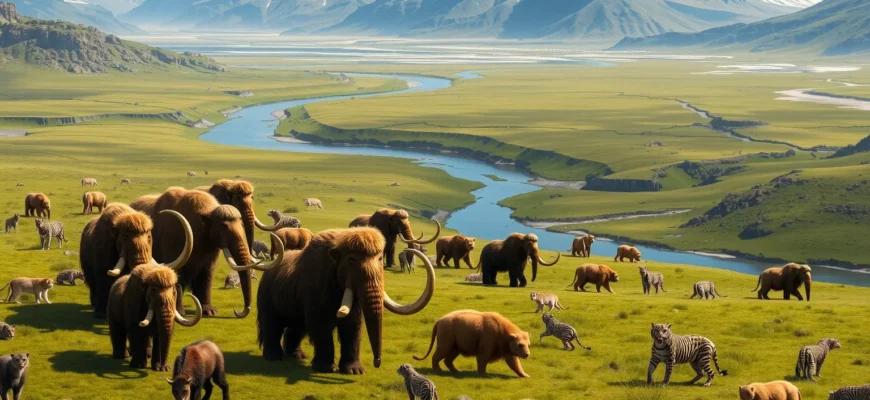
Perhaps the most famous example of this movement is pleistocene park rewilding in northeastern Siberia. Founded by Sergey Zimov, this project aims to recreate the “mammoth steppe,” a highly productive grassland that once dominated the Arctic. By introducing horses, bison, and muskoxen, the project demonstrates how large animals can physically alter the climate.
In the winter, these animals trample the thick layer of insulating snow, allowing the extreme cold of the Siberian air to reach the ground. This process can lower the permafrost temperature by as much as 15 degrees Celsius, significantly reducing the risk of a “methane bomb” release. This makes the project a critical tool for carbon sequestration and global climate stability.
Australia and South America: Managing Accidental Rewilding
In some parts of the world, rewilding is happening by accident. In South America, the “cocaine hippos” escaped from Pablo Escobar’s estate have begun to fill a niche left vacant since the extinction of giant aquatic mammals. Research suggests that these introduced megafauna are rewilding the anthropocene by restoring nutrient transport between aquatic and terrestrial habitats, a function that had been missing for thousands of years.
In pleistocene rewilding australia, the debate centers on feral camels and water buffalo. While often viewed as pests, some ecologists argue these animals are actually performing vital roles in fire suppression and seed dispersal. The challenge in pleistocene rewilding south america and Australia is balancing the benefits of these accidental proxies against the damage they do to native species that evolved in the absence of such large mammals.
The Frontier of Science: Genetic Rewilding and the Ethics of Cloning
As technology advances, the line between conservation and science fiction continues to blur. Genetic rewilding takes the concept of proxies a step further by attempting to edit the genomes of living species to match those of their extinct relatives. This is no longer the stuff of movies; it is a multi-million dollar industry.
The use of CRISPR-Cas9 gene-editing technology allows scientists to “resurrect” specific traits, such as the thick hair and cold-adapted blood of the woolly mammoth, and insert them into the genome of the Asian elephant. This creates a functional hybrid capable of surviving in the Arctic.
Myth vs. Fact: De-Extinction
Myth: Scientists are trying to create a 100% identical clone of a woolly mammoth.
Fact: The goal is to create a functional mammoth-elephant hybrid that can perform the ecological tasks of the extinct mammoth, such as knocking over trees and trampling snow.Myth: De-extinction will replace traditional conservation efforts.
Fact: Genetic rewilding is intended to complement existing habitat protection, providing “ecological tools” that modern animals simply cannot provide.
De-Extinction: Can We (and Should We) Clone a Mammoth?
The work being done by companies like Colossal Biosciences represents the cutting edge of rewilding with cloning. By focusing on the woolly mammoth, they are targeting a “keystone species” whose return could fundamentally alter the Arctic ecosystem. However, this raises profound ethical questions. Should we spend millions on genetic rewilding when modern elephants are facing extinction?
The counter-argument is that genetic rewilding creates a “biological insurance policy.” By adapting elephants to live in the vast, unpopulated regions of the North, we can protect the lineage of these majestic creatures from the poaching and habitat loss they face in Africa and Asia. The ethical focus must remain on the welfare of the animals and the stability of the ecosystems they will inhabit, rather than the novelty of the technology itself.
Rewilding the Anthropocene: Anthropological and Social Perspectives
The success of any rewilding project depends as much on sociology as it does on biology. The anthropology rewilding field studies how humans perceive these “new” old neighbors. For rewilding to work, it must move beyond the “fortress conservation” model and find ways for humans and megafauna to coexist in shared landscapes.
In many cases, the resistance to rewilding is not based on science, but on a cultural fear of the wild. People have become accustomed to “sterile” landscapes, and the idea of sharing the woods with a large predator or a massive herbivore can be jarring.
Coexisting with Giants: The Human Element
Public perception is often the biggest hurdle for megafauna rewilding. To gain local support, projects must demonstrate clear economic and social benefits. In Europe, the return of wolves and bison has led to a surge in eco-tourism, providing a much-needed boost to rural economies that were previously in decline.
Furthermore, we must recognize that indigenous knowledge is a vital component of rewilding. Many indigenous cultures have oral histories and traditional practices that involve living alongside megafauna. By integrating these perspectives, we can create a more inclusive and sustainable model for restoration that doesn’t just look at the past, but builds a future where “wildness” is a valued part of the human experience.
Actionable Steps for Modern Conservation Policy
Implementing a Pleistocene rewilding strategy requires a move away from “all-or-nothing” thinking. Policy makers should focus on incremental steps that build public trust while gathering essential data on ecological impacts.
- Establish “Rewilding Zones”: Designate specific, fenced areas where experimental reintroductions can occur without immediate risk to agriculture or urban centers.
- Prioritize Functional Surrogacy: Focus on species that perform critical ecological tasks, such as seed dispersal or fuel-load reduction, rather than just choosing animals based on their iconic status.
- Implement “Conflict Compensation” Funds: To gain the support of farmers and ranchers, governments must guarantee financial reimbursement for any livestock lost or crop damage caused by reintroduced megafauna.
- Utilize Staged Reintroductions: Start with smaller, more manageable species (like tortoises or wild horses) before moving to larger, more complex animals like elephants or bison.
- Invest in Continuous Monitoring: Use GPS tracking and remote sensing to track the impact of megafauna on vegetation density and soil carbon levels in real-time.
Building a Framework for Responsible Megafauna Restoration
The future of pleistocene rewilding projects depends on a rigorous regulatory framework. This framework must balance the “precautionary principle” (avoiding harm) with the “proactionary principle” (taking calculated risks to achieve a greater good). We cannot afford to wait for perfect certainty while our ecosystems continue to degrade.
Community-led monitoring protocols are essential. By involving local citizens in the tracking and management of rewilded species, we transform “invasive” animals into “community assets.” This shift in perspective is the only way to ensure the long-term viability of megafauna restoration in a crowded world.
Expert Perspective: Functional Ecology
In my professional experience as a palaeoecologist, I have found that people often get trapped in the “originality” of a species. They ask, “Is it exactly the same animal that lived here 10,000 years ago?” I always advise my colleagues and the public to focus instead on functional surrogacy. Wildness is not a snapshot in time; it is a functional state where ecological processes—like nutrient cycling and trophic cascades—operate without constant human intervention. When we use a modern horse to graze the Siberian tundra, we aren’t “faking” the past; we are restarting the engine of the present. The goal isn’t to build a museum; it’s to build a resilient, self-sustaining future.
Frequently Asked Questions
The primary objective is to restore lost ecological processes—such as large-scale grazing and seed dispersal—by introducing modern animals that function as equivalents to extinct Pleistocene megafauna.
Is Pleistocene rewilding happening in North America today?
Yes, though it is currently limited to small-scale projects. The most notable example is the reintroduction of the Bolson tortoise to parts of New Mexico to fill an ancient herbivore niche.
What are the biggest risks of megafauna rewilding?
The major risks include the potential for animals to become invasive, the spread of new diseases, disruption of current habitats, and increased conflict between wildlife and human agricultural activities.
How does Pleistocene Park help fight climate change?
By grazing and trampling snow, large herbivores remove the insulating layer that keeps the ground warm in winter. This deep-freezes the permafrost, preventing the release of methane and carbon dioxide.
Can cloning actually bring back extinct species for rewilding?
Current technology focuses on creating hybrids. For example, scientists are working to insert mammoth DNA into elephant genomes to create a cold-resistant animal that can perform the mammoth’s ancient ecological role.
Why is the year 2012 significant in rewilding history?
2012 was a pivotal year for academic refinement, where researchers moved beyond broad theories to propose specific, actionable frameworks for megafauna restoration in the Americas and beyond.